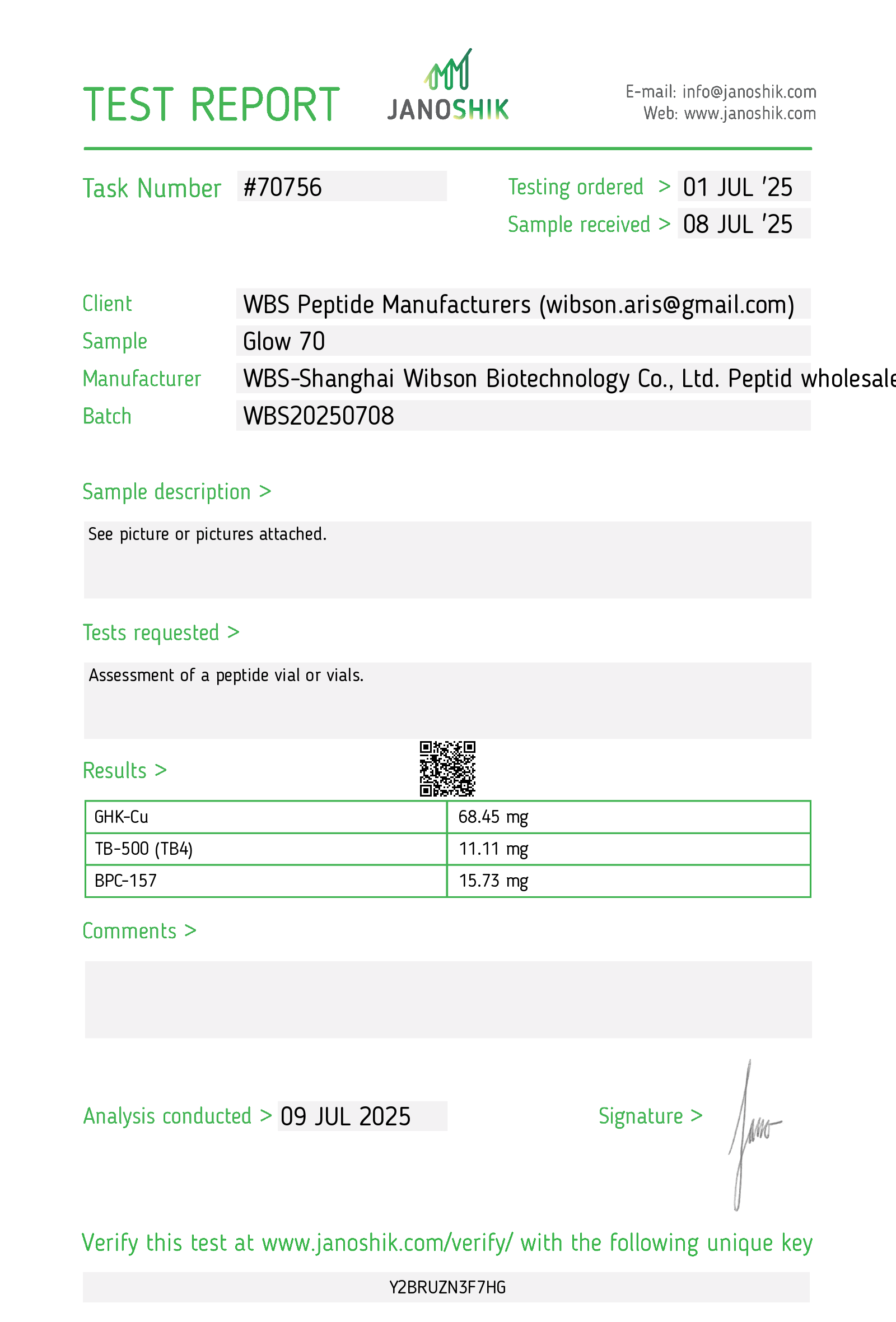
GLOW-70 is a 70 mg per vial co-lyophilized research blend containing GHK-Cu 50 mg, TB-500 10 mg, and BPC-157 10 mg; each kit contains 10 vials. The formulation is intended for controlled studies of extracellular-matrix remodeling, actin-linked cell migration, endothelial signaling, and multi-peptide formulation behavior. The exact blend has not been clinically validated. For laboratory research use only.
GLOW-70 is a defined three-component blend, not a single peptide. Each vial contains GHK-Cu 50 mg, TB-500 10 mg, and BPC-157 10 mg, for a total nominal content of 70 mg. The components are co-formulated so researchers can examine overlapping repair-related pathways and the analytical behavior of a multi-peptide mixture.
These mechanisms describe research on the individual components or closely related materials. No direct published study was identified for this exact 50:10:10 co-lyophilized formulation. Synergy, potency, stability, and biological response must therefore be measured for the blend itself and must not be inferred by simply adding the reported effects of the separate components.
This product is supplied as a lyophilized powder. Unopened vials can be stored at room temperature for up to 2 years when kept sealed, dry, and protected from light. Avoid excessive heat, moisture, and repeated temperature changes during storage.
After reconstitution, store the solution at 2-8°C, protected from light, and use it within 30 days. Label the vial with the reconstitution date. Use sterile handling, avoid vigorous shaking and repeated freeze-thaw cycles, and do not use the material if the seal is damaged or if persistent particles, unexpected cloudiness, or discoloration is present after dissolution.
For concentration calculations after adding V mL of solvent, the nominal component concentrations are GHK-Cu 50/V mg/mL, TB-500 10/V mg/mL, and BPC-157 10/V mg/mL. The total nominal blend concentration is 70/V mg/mL. Reconstitution volume changes concentration but does not change the fixed 5:1:1 mass ratio. Use the lot-specific COA and an appropriate analytical method when measured concentration or identity is required.
Each vial contains GHK-Cu 50 mg, TB-500 10 mg, and BPC-157 10 mg, for 70 mg total nominal peptide/blend content. One kit contains 10 vials.
It is the sum of the labeled component masses in one vial: 50 mg + 10 mg + 10 mg = 70 mg. It is not the amount of each individual component.
No direct published study was identified for this exact 50:10:10 blend. Individual components have been studied in different in-vitro and animal models, but those findings do not prove that the combined vial has additive or synergistic activity.
No. They are supplied as a co-lyophilized mixture. Reconstitution produces one solution with a fixed nominal 5:1:1 mass ratio, so experiments requiring isolated components should use separately characterized materials.
GHK-Cu is a copper complex and can contribute a blue coloration. Color intensity may vary with concentration, formulation, and lighting. Persistent particles, unexpected cloudiness, or a marked change from the lot reference should be documented and reported before use.
Add the selected laboratory solvent slowly down the vial wall and swirl gently. Do not shake vigorously. Keep the reconstituted solution protected from light at 2-8°C and follow the lot-specific COA or stability instruction.
No. GLOW-70 is sold as a laboratory research material. The component mechanisms described here are largely based on in-vitro and animal research and are not dosing or treatment guidance.
Contact our online support for real-time communication about products, orders, shipping, payment, or bulk supply.